A HYBRID NOTEBOOK OF POETICS AND PORNOGRAPHIES

Pornography Disclaimer

This is a an imaginary diary of facts, confessions, or messages. This is a notebook of working but broken ideas, lines, images, notes on books I'm reading, writers I admire, and brief fantasies of language. Here unfiltered  all mannerings pseudo-private, publicized, ur-. Here I am art and unrevealed: poetic, political and pop. These are my moonlit rough beginnings and should not be taken literally, directly, truthfully, reliably, and none of it is legally binding. These lies are all choreographed, but only haphazardly. Beware.
Showing posts with label Cavafy. Show all posts

1.1.07

PURE DAYLIGHT IS THE STONE

Except that Cavafy is always discussing sex,

only he never seems to be in the clutches, as I pointed out in my last entry, like Rigoberto Gonzalez, who's absolutely gripping, clawing, entering, being undone by, torqued, worn, re-bodied and re-boundaried by violent desires--where sex is his religion, the death of self and the resurrection. The body too is exchanged in this transformation of person, except in Cavafy there's no psycho-porn, there's only the momentary reminiscence of lips and face and hair.

It's this distance that demands oblique, antique phrases like "erotic pleasure" to Gonzalez' frank, "finger, foot, cock," that I'm referring to when I call Cavafy a Gay Republican. Tonight I'm haunted by the feeling that I was brazen and wrong, that I've hurt my feelings for Cavafy--

that I've wounded a secret love. Though I'm right to say he's a demon with a blue eye.

. . . . .

"Picture Of a 23 Year-Old Painted By His Friend Of the Same Age, An Amateur"

He finished the picture yesterday noon.
Now he looks at it detail by detail. He's painted him
wearing an unbuttoned gray jacket,
no vest, tieless, with a rose-colored
shirt, open, allowing a glimpse
of his beautiful chest and neck.
The right side of his forehead is almost covered
by his hair, his lovely hair
(done in the style he's recently adopted).
He's managed to capture perfectly the sensual note
he wanted when he did the eyes,
when he did the lips. . .
That mouth of his, those lips
so ready to satisfy a special kind of erotic pleasure.

. . . . .

Friends and Strangers, Gonzalez' achievement is that he risks the psychotherapeutic "I" to descend into sexuality, when most contemporary poets use it to romanticize a family drama (still clouded, unknowing Lowell-ists) or to document the daily mundane (as if pure journalism could serve us as poetry), poorly idolizing W.C. Williams. Sex is horror. The challenge for Gonzalez, Sexton, and anyone else who attempts sex as subject (say Bidart, or more recently Siken) is that to avoid being funny or caricaturist, the poem must be more than provocative. Its nature is to shock us. Poets of sexual descent, especially those of us affected by post-modernist sensibilities, have to worry whether this shock will be discredited as pornographic or simply poorly executed. This is not a concern for Cavafy, whose distance from sex itself is as great as the distance between the stone and the light, the living and the remembered.

. . . . .

How do we achieve, on the other hand, something contemplative, quiet, unless we write like Cavafy, apart, at a distance. Is it possible to disrobe in a poem? I mean to actually fuck in a poem? Can poetry succeed in the middle of a sexual display, can poetry really achieve its own Dyonisian impulse and not result in sounding disturbing?


Cavafy is forever considering loss, and not really sex. He's a sensualist, and in the end sensualism is always adorned by a death. His young dead lover is ever stoned by the light of his memory.

For me Henri Cole is more like Cavafy than Gonzalez. His approach is distanced by omniscience, the recounting of a memory. It's so internalized, quiet--and, like Cavafy, this is a mark of its beauty. But it's so much an inward movement that we end up in the air. It's as if he's reading an obituary. It's as if the experience belongs to any of us, and especially to someone else.


"Blur 2"


The strong sad ritual between us could not be broken:

the empathetic greeting; the apologies

and reproaches; the narrow bed of his flesh;

the fear of being shown whole in the mirror

of another's fragmentation; the climbing on;

the unambiguous freedom born of submission;

the head, like a rock, hefted on and off moist earth;

the rough language; the impermeable core

of one's being made permeable; the black hair

and shining eyes; and afterward, the marrowy

emissions, the gasping made liquid; the torso

like pale clay or a plank, being dropped;

the small confessional remarks that inscribe

the sole; the indolence; the being alone.


The power of a poem like this is that in the end we're greedy eavesdroppers--because this is someone else's life, we're reading his journal, he's talking to himself, offering his fallen confession, but we're listening too, secretly, and it sounds like our own experience in the embrace of a shadow: "the impermeable core / of one's being made permeable". Cole succeeds in a compelling exhibitionism without an ounce of vulgarity. I mean, "marrowy / emissions, the gasping made liquid"? You couldn't get any more exact and simultaneously non-descript.

. . . . .

The need for an illicit poetry that addresses taboo sensuality is not new, but it belongs to those tragic personages who risk their lives and public reputations to make of themselves an offering. Think de Sade or Georges Bataille. Think Verlaine and his disastrous affair with Rimbaud. Oscar Wilde, James Joyce, Henry Miller, Collette (god the French!), Anaiis Nin, Sexton, Kathy Acker. . . To write explicity about sex means you have to offend, challenge, face the admonition of the religious fear-mongers. And yet,

I started writing this to address Cavafy, to apologize for calling him a Gay Republican. Was that unfair? It was to reference his honesty about sexual identity masked with the daylight frankness with which he absolutely avoids sexuality altogether. Of course, this is blameless. Sexuality wasn't his subject at all--it was longing, and how the body torments us because it sails.

I started writing this to address and to define the boundary of erotic poetics, and whether a style of confessional honesty can offer us beautiful poems, or merely disturbing ones. Is the horror of sexual encounter, the terror of losing self, body, boundary, identity, all to the administering of physical pain--the bite, the lash, the orgasm--a realm where poetry can love? We are writing somewhere between the erotic and the sexually vulgar. We are balancing death with love. Love sends us a message:--from the distant light of his eyes to the hot presence of this blood--Naughty is the new Nice.

. . . . .

I don't know whether there is a poetry that couples the vulgar and the romantic, one that balances memory with the intensity of the sexual act itself. If this kind of poem exists, is it a descendant of something cultured or something brutal? Cavafy or Lorca? Straightforward Imagery or Symbolic Metaphor? Nature or Nurture?

I'm thinking now of Carl Phillips, whose work at first, because of the pressure of its syntax, feels related to Cavafy in terms of its portrayal of men in relationships, its reference to classical texts and figures and history, and the clarity of its imagery. (Though, for me, his resemblance to Donne--in terms of the metaphysical intensity of his work--is even more striking). But reading any of his books, you realize he's fearlessly grazing on the vulgar. But like Lorca, he gives it to us like a burning romantic. Even though he's over us, our whole obsession with romantics, with desire. Still, he's faced with the reality of it. How dow we write about something so boring? When every other heart has a love song to cry over? So he's an intellectual, and he's filthy rich, and he's bored with the help--but he's in love, and god it's gross to have to write about it, but oh. His syntax is trying to mezmerize us, hypnotize us. He really has to work hard to cast a spell. Its the beauty of philosophy, that has something sure to say, crossed with the irony of one who's self conscious of his own reflection in the water. He yawns and rolls his eyes and waves down to himself, Cold Narcissus. Well, what's one more poem to you, Friend and Stranger?

(And then the breeze comes through like a secret violence--that like Bishop happens syntactically:

"I love) I shan't have lied. It's evident"

and the whisper of it's enough to reduce us to the lost petals of his looks. . .

. . . . .

"Quarter-View, From Nauset"


Love, etc. Have been remembering
the part in Sophocles
where a god advises the two heroes

they should be as
twin lions, feeding--how
even the flesh of late

slaughter does not
distract them from keeping
each over the other

a guarding eye.
What part of this is love, and
what survival

is never said,
though the difference it makes is
at least that between a lily and, say,

a shield. I think of you
often, especially here,
at the edge of the world or a

part of it, anyway,
by which I mean of course
more, you will have guessed, than

the coast, just now, I
stand on. Against it,
the water dashes with

the violence of two men who,
having stripped it, now take for their
own the body of

a third man on the bad
sofa of an even worse
motel room in what eventually

is movie--one
we've seen . . . The way
what looks like rape

might not be. You'd like
the light here. At
times, a color you'd call anything but blue.

31.12.06

LOST NOTES FROM PRISONS AND FLOWERS


Late last night the nightabyss opened from within like a blue flower. The television watered. I walked from my cup of coffee to the black door and listened. I held Rigoberto Gonzalez' new book of poems, Other Fugitives and Other Strangers. My ex lover was asleep in the next room, I was here, lit by the black lamp of my coffee. There is a Silence underneath things that comes undone, Undead Duende. The hinges come loose. We fall through ourselves. The stars are spies.

. . . . .

The book jacket says of Gonzalez' work, "this book is a testimony to sexuality in times of violence . . . expressed through a dark eroticism reminiscent of Garcia Lorca and Cavafy."

Tonight I'll begin with envy, the lash.

This is West Hollywood, friday night, between 1:30 and 2:30 a.m. Outside two Israeli men walk up the dark hill toward the cold wall of stars. They are yelling and singing their national anthem. They are shouting their drunken brotherhood like the shouting orphans of eachother's arms.

The book cover is beautifully written, but needling me. Something about it doesn't capture what I found brave, dangerous, disturbing about this work. I want to say something about the calling of this book, and what it does to me, what it might be doing to others. How is Gonzalez texting Lorca, Cavafy, and why isn't this an answer to my love? It's needling me--green, nervewild. But tread carefully here, o world of enemy lovers. This is worth hours in the nightabyss. Read it. Buy it. Steal it. But I want to descend here into its aspirations. If touch is a prison. . .

. . . . .

Tonight on my ITunes I've got one song on repeat: "Battlestations" by Wham. Hot skip of a baseline and high chime. It's edgy and hot: All I'm trying to give you is a good time honay / Whydju have to keep on playing games with my head? / Used to be a babay when u had no monay / Now we spend more time in battle than we ever do in bed! / . . . Than we ever do in bed! It's a prediction of Madonna's Erotica before she met Lenny Kravitz. It's a phone message in french with an 80's torn slutlook. It's Music from the Edge of Heaven. Get it. Wear it out.

. . . . .

Both Lorca and Cavafy write from behind the necessity of a mask. In the end what makes their work compelling is a kind of imposed restraint. In Lorca, metaphor is denial. The psychosexual drama of metaphor suppresses any kind of overt political statement, but also compresses erotic feeling into the intensity of imagery we expect from him.


Take his dark sonnets, poems where the dark lover is the summoned phantom of his victim. Blindness and boy love, the strength of his imagery lies in the intuitive psychodrama inherent to his hidden sexuality. Wound, you are the blue fountain of my cries. Thorn, you are impenetrable, the black prince of my flesh. Lorca, Supple Icon laid across my sleeping lover's torso. In Lorca, everything is the body, is blood and darkness and love. When Gonzalez is Lorca, he's whispering things like "the heart keeps pumping / like an anxious rabbit."

. . . . .

Cavafy is pure daylight. His disguise is domesticity, tears in his hands one afternoon at the cafe. He's got his eye on a bit of sunlight striking the staircase to a secret room upstairs. He's sort of Republican Gay, conservative and private. He likes fresh yellow tulips in a white vase. Pressed shirts. Waxed brows and manicures. He's out, but can avoid politics by insisting on etiquette. It's impolite to discuss money, politics, and sex. So instead he's memory. Untenable men he once loved. Affairs to remember, a name, an age, the style of his haircut, the style of his death. His look is from a doorway he's too afraid to cross. Absence is the face of the young lover. When Gonzalez is Cavafy, he's privately remembering "the blame

of pleasure. The pain I exit no greater
than the loneliness that takes me to the bar.
He says good night, I give him back
those words, taking nothing with me that is his.
The front door shuts behind me, the gravel
driveway ushers me away. The rearview mirror
loses sight of threshold, house, sidewalk, street.


For Cavafy, loneliness is the condition of his love. Impossible they, him, you. Impossible pronoun, gazing upon the possible version of his own life.

. . . . .

Why the editors compare Gonzalez' work to Cavafy, and to Lorca, has to do primarily with the fact that like these two, he takes masculine imagery and the homosexual relationship as his primary subject. In this book Gonzalez understands that the joys of taboo involve brutality as pleasure. But where Gonzalez departs--and I would argue that if his book is a brother to works by Cavafy and Lorca, it's not necessarily by subject matter alone--it's in his directness, his frank confessionalism, or the style of it. Yes--friends and strangers--style is the green needle tonight. What is most compelling about either Lorca or Cavafy's work is a result of their inability to directly address their sexuality. This results in poems of intuitive, political intensity--without acknowleging these realms at all. For Lorca it is a Blood Drama, and for Cavafy it is something recounted or imagined by a distance in time. Their real subject is desire, longing, and our inability to clutch the demon princes of our sight.

. . . . .

Tonight's moon is a podcast. 1-800-I-Confess. Young Madonna, it's been half a night since I knelt before the cross of his love. The breath of the ex-lover asleep is rushing beside me like an orange tree at night, wrestling the cool attention of a wind. Two weeks ago my grandmother from Sonora gave me a bracelet made of tiny wooden santos. Virgens, guardian angels, Jesus with the pierced shield of his heart across his chest. Wear this, she said. Don't take it off, or you'll die and go straight to hell.

. . . . .

This is the beginning of the 21st century and in it we are all very post-Freudian-modern. If Lorca and Cavafy are unwitting poets of desire, Gonzalez is a sexually contemplative poet of psychological encounter and gay identity. In fact, this is why his work is dangerous, brutal, unforgiving: he is self-aware, scrutinizing, and unforgivably confessional, even if he's not confessing. In this respect, his poems, for me, have a more direct communion with say, Sexton, than either more fantasized homoerotic poets. I'm not sure Gonzalez' work is erotic at all. Sexuality is the realm of horror and of the divine, but not the realm of longing. Not the slow look, the swelling need. This book is a fugitive of that Keatsian lean and paused flower of the Almost, Imaginary Kiss.

More often, Gonzalez is Sexton: "I suspect / you slip your finger in me while I sleep, / expecting me to suck the menace out." Or, "My lover feeds and fattens . . . this keen scavenger / finds value in that vacancy and stuffs it / with himself--cock, finger, foot." He is scorned mistress, boy adulterer. His subject is his sexuality, how it reveals him to the joys of slavery, the transformative boundaries that are constantly crossed and re-written as he becomes himself a wounded lover. His body, then, is the realm of pleasure and belief and death: "the gulluble anus or seductive // cock, both easy / to please. What I love about this book is its frankness about gay sexuality, the dynamic of lovers without that presentiment of permanence and marriage that haunt and comfort straight lovers. We are fly-by-midnights--a wound tells us
at dawn we were loved.

We are, by nature, transgressive. Gonzalez is writing the brutal honesty of our lovesex in the confessional: "Before I kneel to kiss your cock I remove its cross and hang it back on the wall. To open your cheeks to expose the chalice of your ass is to find the pink lips of Catholics."

On the other hand, it's this very frankness that straddles the pole of vulgarity. How much of this confessional tone can we take, before the poem turns gross? I ask, not as criticism per se of Gonzalez, but as a genuine concern in my own work. For me, lyricism can save the vulgar from sounding crude, though I worry--it's difficult to live here on the edge of saintliness. We either achieve brilliance, or a bad diary entry. Mishima said the only hands that touch God are the Masturbater's.

For me this book wavers on the fringes of this worry. At times deeply

they'll hold
down the lonely
dawns for you.

At times these poems will bare themselves so perfectly you'll flinch and wonder whether you can bear it, the way Gonzalez bares a bothersome attention to sex itself, that we know is best when ugliest.
My photo
I've got one foot in the grave and the other's in my mouth.

Poetry Disclaimer

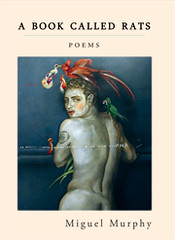
My work has been awarded the Katherine C. Turner Prize from the Academy of American Poets, a Swarthout Award, and has twice been nominated and shortlisted for the Pushcart Prize. My first book, A Book Called Rats, was selected for the Blue Lynx Prize for Poetry (Eastern Washington University Press 2007). I'm curating editor for the online journal of poetry: PISTOLA and my poems and reviews most recently appear in Massachusetts Review, Beloit, Ploughshares and RAIN TAXI. I currently teach writing and literature at Santa Monica College in southern California.
bookcalledrats