A HYBRID NOTEBOOK OF POETICS AND PORNOGRAPHIES

Pornography Disclaimer

This is a an imaginary diary of facts, confessions, or messages. This is a notebook of working but broken ideas, lines, images, notes on books I'm reading, writers I admire, and brief fantasies of language. Here unfiltered  all mannerings pseudo-private, publicized, ur-. Here I am art and unrevealed: poetic, political and pop. These are my moonlit rough beginnings and should not be taken literally, directly, truthfully, reliably, and none of it is legally binding. These lies are all choreographed, but only haphazardly. Beware.
Showing posts with label Phillips. Show all posts

30.6.09

STOLEN SHALLOWS

Solitude and twilight on the late shores. Cold blaze
of the waves' steady visitations. Footstep, hint of moonlight

into the soft dark sand: fist, or halo.
If I leave something white there, if I stand

my body against the night's three darknesses, ocean,
wind, and black calm . . . what

will I call this hour? Of my flesh broken
against the fleshless machinations the always resonant

flooding of time? Storm. Sickness. Waste. Belief. My frail
small human breath in the loud and emptied, emptying, gleam.

The night-flooding mind. Milkweed.

. . . . . .

I come inside and read Carl Phillips and know what it is to face that boundary between mind and world, the sensual boundary where sex and prayer collide. Speak Low, his latest book, in unafraid of the difficulty of describing human emotion, human mind. Our predicament, they seem to insist, whether it is love or history, is a metaphysical one. That is, it is faced with an understanding of abstraction hinged to experience. Plato thought that what exists lay beyond experience, but these poems use nature as a kind of relative explanation, a pathetic fallacy which helps us to try and understand our human considerations of time, love, history, faith. What I love most about Phillips is his unapologetic use of abstraction as a way to consider human experience--he uses a language most poets (perhaps schooled in the standard "show don't tell" arena of MFA programs) avoid for the most part altogether.

Patterns are of particular significance to this book: the physics of light, water, shadow, as well as the movement of animals, birds, and how the human mind might observe or interpret them. His poems have this almost archaic quality that allude to historical moments and intellectual movements of the Enlightenment at once. They are wrought, moreover, in a way that describes what is most familiar to us, though private, intimate, and even erotic: this, for example, is from the poem "Rubicon", a political point of no return, a river Caesar crossed illegally in 49 B.C., devoting himself to war against the senate, and also a game in which the loser's points are tallied for the winner:

. . . that moment in intimacy
when sorrow, fear and anger cross in unison the same face,
when at first can seem almost

a form of pleasure, a mistake as
easy, presumably, as it's forgiven."


History and philosophy here take on a life in the face of the beloved in the most alluring and attentive way. The more I read Phillips' poems, the more dissatisfied I am with a poetry of narrative(?) description. There is a weight to these lyrics that demands a secondary attention, our experience of the abstract world of emotion. How is it we've interpreted not just what we've seen in the world, but what we've felt?

. . . . . . .

Beautiful Dreamer

And when the punishment becomes, itself a pleasure?
When there's no night that goes unpunished? The larger
veins show like map work, as in Here winds a river,
here a road in summer, the heat staggering up from it
the way always, at triumph's outermost, less chromatic
edges, some sorrow staggers. Parts where the mud,
though the rains are history now, refuses still to
heal over. Parts

Untranslatable. Parts where, for the whole
stretches, vegetation sort of strangling sort of makeshift
sheltering the forest floor. To the face, at the mouth
especially, that mix of skepticism, joy, and panic reminiscent
of slaves set free too suddenly. Too soon. --Which way's
the right way? New hunger by new hunger? Spitting
on weakness? Raising a fist to it? The falling mouth falls
farther. Opens. It says, I was the Blue King. I led the dance.

. . . . . .

Eliot, in his 1929 essay, "The Metaphysical Poets" makes a distinction between the Romantics and their 17th century predecessors:

"it is the difference between the intellectual poet and the reflective poet. Tennyson and Browning are poets, and they think; but they do not feel their thought as immediately as the odour of a rose. A thought to Donne was an experience; it modified his sensibility. When a poet's mind is perfectly equipped for its work, it is constantly amalgamating disparate experience; the ordinary man's experience is chaotic, irregular, fragmentary. The latter falls in love, or reads Spinoza, and these two experiences have nothing to do with each other, or with the noise of the typewriter or the smell of cooking; in the mind of the poet these experiences are always forming new wholes."

This is precisely what I love about Phillips: his thought is his experience. Symbolic, or fragmentary, the world takes place in his poem, and his speaker feels them. He does not fail, even if he does not explicate, the many disparate parts of his knowledge and identity.

I'm not a critic, I'm a commentarist--I read so that my inner life can save me from the brutal ugliness of this outer one. I write here about what I love, in a shameless way that a real critic has good reason to berate. A real critic may say something about Phillips' abstraction in that it goes too far for an average reader, that it obfuscates issues of identity, gender, race, class, all of those realms of experience we hold so specific and dear in this age. But when I read him, I feel that his poems teach me to read in a silence I had not before considered, a silence like prayer, a kind of devotion to an inner life I crave. I think if you read closely enough, you'll find these identities: the historical self and the fantasist: the poet and the philosopher: desired god and beloved flesh: all are given semblance. Yes, they are difficult to learn to read, especially, I think, for a novice reader, but they are deeply necessary in that they refuse to simplify the complexity in which the human mind renders itself.

Much more can be made of the comparisons between Phillips and Donne, nowhere perhaps more evident than in Phillips' collection The Rest of Love, in which the lover becomes a god of leather, commandment, relentless conditional belief. But this later collection seems more allusive to spiritual hymnals. Its tone is one of sad reminiscence for a spiritual freedom: to love? To understand death? To be free of bodily suffering? I'm not sure, exactly, perhaps all three. I do know that the joy of these poems comes from the middle of a pain, an isolation, that is basic, something Frost might have written about, inherent, too human, often unspoken for.

Friends and Strangers, steal it if you can!

. . . . . .

Landfall

From here, I can see that ritual is but a form of
routine charged with mystery, and the mystery is faith--
whatever, by now, that might be. Twilight. The usual
eyeful of stars appearing, looking the way stars at first
always do: locked; stable.

My friend, to whom
sadness had once felt almost too familiar--Step into it,
he used to say, stare up and out from it--tells me now
he misses it. He wants to know does that mean
he's happy?

In the dark, he turns to me. The silences
rise to either side of us: silence of intimacy when
estranged from risk; of risk itself when there's no one
to take it--nobody willing to; silence, by which the dead
can be told more easily apart from the merely broken . . .

. . . . . . .

5.4.07

MY BLIND MOTH

. . . . .

Friends and Strangers, working lately to summon my own authenticity, to write from the world when I am that alone--alone enough to find out what intimacy really is when it is a knowing blindness, a knowledge of something beyond this shore of words.

Visiting us kindly from some beautiful half-sleep

What deep light our dark phantoms return


MOTH

by Paisley Reckdal

Hours after the storm and still I don't know why I'm caught
on my porch before the body of this moth,
big as a plumber's thumb and bullet-shaped,
shoulders covered with fine and surprising fur.
Everything about it, down
to the crossed and modest-seeming legs,
paddle-shaped antennae and the wings
slick as variegated satin
beckons, holds me to it: the eyes
glossy pinheads inside which
thousands of small cells bristle, rimmed with gold,
rimmed mercury and onyx:
a rich multiplicity from which
to no longer see the world.
It is cold and late, I am tired but cannot stop
staring at this shadow growing in my hands,
long as a dog's paw, skin and hair
so articulated as to be rippling in stillness.
The hollowed belly tapers to a bee-sting point
off which only the tiniest gray tuft of hair
bursts, as if the body were incapable of defending itself
through any means other than deception
or pleasure. Which makes
the sudden underwings' tabs of pink
more poignant a discovery,
a shredding of lipstick, silken powdering.
I want to scratch away at it, drag this color
with me, paste its scent onto face and hair
and clothing. I don't know why
I hesitate to bring it into the house,
to prop it on the kitchen table where the light
is better, nudging apart its stiff legs.
I can't stop stroking the wicker hooks growing
out of its face, imagining how a chain
might be threaded through them and the whole thing worn
as a necklace, a charm
for the cats that will soon appear, and then the owls,
more stars and clouds; even for the moon
rolling her stone face up to the black surface.
I'm not afraid of death, Im afraid of all the years
leading up to it. Still, I'll be thinking of this moth
all week, and the weeks after, remembering
how I wanted to kneel before this ancient furred body,
to slip it into my mouth,
savoring the heat of whatever last light
might have killed it.
The moth is frail. It feels like nothing.
And the rain wihdraws its wet cape
slowly from my shoulders as I continue to stand here,
looking and looking at what I won't release,
to watch it shake its ice of walkway dust
and start once more, back to the lamp
on the kitchen porch, to lift again and linger at a source
from which there is no dark.

. . . . .

1.1.07

PURE DAYLIGHT IS THE STONE

Except that Cavafy is always discussing sex,

only he never seems to be in the clutches, as I pointed out in my last entry, like Rigoberto Gonzalez, who's absolutely gripping, clawing, entering, being undone by, torqued, worn, re-bodied and re-boundaried by violent desires--where sex is his religion, the death of self and the resurrection. The body too is exchanged in this transformation of person, except in Cavafy there's no psycho-porn, there's only the momentary reminiscence of lips and face and hair.

It's this distance that demands oblique, antique phrases like "erotic pleasure" to Gonzalez' frank, "finger, foot, cock," that I'm referring to when I call Cavafy a Gay Republican. Tonight I'm haunted by the feeling that I was brazen and wrong, that I've hurt my feelings for Cavafy--

that I've wounded a secret love. Though I'm right to say he's a demon with a blue eye.

. . . . .

"Picture Of a 23 Year-Old Painted By His Friend Of the Same Age, An Amateur"

He finished the picture yesterday noon.
Now he looks at it detail by detail. He's painted him
wearing an unbuttoned gray jacket,
no vest, tieless, with a rose-colored
shirt, open, allowing a glimpse
of his beautiful chest and neck.
The right side of his forehead is almost covered
by his hair, his lovely hair
(done in the style he's recently adopted).
He's managed to capture perfectly the sensual note
he wanted when he did the eyes,
when he did the lips. . .
That mouth of his, those lips
so ready to satisfy a special kind of erotic pleasure.

. . . . .

Friends and Strangers, Gonzalez' achievement is that he risks the psychotherapeutic "I" to descend into sexuality, when most contemporary poets use it to romanticize a family drama (still clouded, unknowing Lowell-ists) or to document the daily mundane (as if pure journalism could serve us as poetry), poorly idolizing W.C. Williams. Sex is horror. The challenge for Gonzalez, Sexton, and anyone else who attempts sex as subject (say Bidart, or more recently Siken) is that to avoid being funny or caricaturist, the poem must be more than provocative. Its nature is to shock us. Poets of sexual descent, especially those of us affected by post-modernist sensibilities, have to worry whether this shock will be discredited as pornographic or simply poorly executed. This is not a concern for Cavafy, whose distance from sex itself is as great as the distance between the stone and the light, the living and the remembered.

. . . . .

How do we achieve, on the other hand, something contemplative, quiet, unless we write like Cavafy, apart, at a distance. Is it possible to disrobe in a poem? I mean to actually fuck in a poem? Can poetry succeed in the middle of a sexual display, can poetry really achieve its own Dyonisian impulse and not result in sounding disturbing?


Cavafy is forever considering loss, and not really sex. He's a sensualist, and in the end sensualism is always adorned by a death. His young dead lover is ever stoned by the light of his memory.

For me Henri Cole is more like Cavafy than Gonzalez. His approach is distanced by omniscience, the recounting of a memory. It's so internalized, quiet--and, like Cavafy, this is a mark of its beauty. But it's so much an inward movement that we end up in the air. It's as if he's reading an obituary. It's as if the experience belongs to any of us, and especially to someone else.


"Blur 2"


The strong sad ritual between us could not be broken:

the empathetic greeting; the apologies

and reproaches; the narrow bed of his flesh;

the fear of being shown whole in the mirror

of another's fragmentation; the climbing on;

the unambiguous freedom born of submission;

the head, like a rock, hefted on and off moist earth;

the rough language; the impermeable core

of one's being made permeable; the black hair

and shining eyes; and afterward, the marrowy

emissions, the gasping made liquid; the torso

like pale clay or a plank, being dropped;

the small confessional remarks that inscribe

the sole; the indolence; the being alone.


The power of a poem like this is that in the end we're greedy eavesdroppers--because this is someone else's life, we're reading his journal, he's talking to himself, offering his fallen confession, but we're listening too, secretly, and it sounds like our own experience in the embrace of a shadow: "the impermeable core / of one's being made permeable". Cole succeeds in a compelling exhibitionism without an ounce of vulgarity. I mean, "marrowy / emissions, the gasping made liquid"? You couldn't get any more exact and simultaneously non-descript.

. . . . .

The need for an illicit poetry that addresses taboo sensuality is not new, but it belongs to those tragic personages who risk their lives and public reputations to make of themselves an offering. Think de Sade or Georges Bataille. Think Verlaine and his disastrous affair with Rimbaud. Oscar Wilde, James Joyce, Henry Miller, Collette (god the French!), Anaiis Nin, Sexton, Kathy Acker. . . To write explicity about sex means you have to offend, challenge, face the admonition of the religious fear-mongers. And yet,

I started writing this to address Cavafy, to apologize for calling him a Gay Republican. Was that unfair? It was to reference his honesty about sexual identity masked with the daylight frankness with which he absolutely avoids sexuality altogether. Of course, this is blameless. Sexuality wasn't his subject at all--it was longing, and how the body torments us because it sails.

I started writing this to address and to define the boundary of erotic poetics, and whether a style of confessional honesty can offer us beautiful poems, or merely disturbing ones. Is the horror of sexual encounter, the terror of losing self, body, boundary, identity, all to the administering of physical pain--the bite, the lash, the orgasm--a realm where poetry can love? We are writing somewhere between the erotic and the sexually vulgar. We are balancing death with love. Love sends us a message:--from the distant light of his eyes to the hot presence of this blood--Naughty is the new Nice.

. . . . .

I don't know whether there is a poetry that couples the vulgar and the romantic, one that balances memory with the intensity of the sexual act itself. If this kind of poem exists, is it a descendant of something cultured or something brutal? Cavafy or Lorca? Straightforward Imagery or Symbolic Metaphor? Nature or Nurture?

I'm thinking now of Carl Phillips, whose work at first, because of the pressure of its syntax, feels related to Cavafy in terms of its portrayal of men in relationships, its reference to classical texts and figures and history, and the clarity of its imagery. (Though, for me, his resemblance to Donne--in terms of the metaphysical intensity of his work--is even more striking). But reading any of his books, you realize he's fearlessly grazing on the vulgar. But like Lorca, he gives it to us like a burning romantic. Even though he's over us, our whole obsession with romantics, with desire. Still, he's faced with the reality of it. How dow we write about something so boring? When every other heart has a love song to cry over? So he's an intellectual, and he's filthy rich, and he's bored with the help--but he's in love, and god it's gross to have to write about it, but oh. His syntax is trying to mezmerize us, hypnotize us. He really has to work hard to cast a spell. Its the beauty of philosophy, that has something sure to say, crossed with the irony of one who's self conscious of his own reflection in the water. He yawns and rolls his eyes and waves down to himself, Cold Narcissus. Well, what's one more poem to you, Friend and Stranger?

(And then the breeze comes through like a secret violence--that like Bishop happens syntactically:

"I love) I shan't have lied. It's evident"

and the whisper of it's enough to reduce us to the lost petals of his looks. . .

. . . . .

"Quarter-View, From Nauset"


Love, etc. Have been remembering
the part in Sophocles
where a god advises the two heroes

they should be as
twin lions, feeding--how
even the flesh of late

slaughter does not
distract them from keeping
each over the other

a guarding eye.
What part of this is love, and
what survival

is never said,
though the difference it makes is
at least that between a lily and, say,

a shield. I think of you
often, especially here,
at the edge of the world or a

part of it, anyway,
by which I mean of course
more, you will have guessed, than

the coast, just now, I
stand on. Against it,
the water dashes with

the violence of two men who,
having stripped it, now take for their
own the body of

a third man on the bad
sofa of an even worse
motel room in what eventually

is movie--one
we've seen . . . The way
what looks like rape

might not be. You'd like
the light here. At
times, a color you'd call anything but blue.
My photo
I've got one foot in the grave and the other's in my mouth.

Poetry Disclaimer

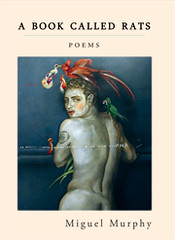
My work has been awarded the Katherine C. Turner Prize from the Academy of American Poets, a Swarthout Award, and has twice been nominated and shortlisted for the Pushcart Prize. My first book, A Book Called Rats, was selected for the Blue Lynx Prize for Poetry (Eastern Washington University Press 2007). I'm curating editor for the online journal of poetry: PISTOLA and my poems and reviews most recently appear in Massachusetts Review, Beloit, Ploughshares and RAIN TAXI. I currently teach writing and literature at Santa Monica College in southern California.
bookcalledrats