A HYBRID NOTEBOOK OF POETICS AND PORNOGRAPHIES

Pornography Disclaimer

This is a an imaginary diary of facts, confessions, or messages. This is a notebook of working but broken ideas, lines, images, notes on books I'm reading, writers I admire, and brief fantasies of language. Here unfiltered  all mannerings pseudo-private, publicized, ur-. Here I am art and unrevealed: poetic, political and pop. These are my moonlit rough beginnings and should not be taken literally, directly, truthfully, reliably, and none of it is legally binding. These lies are all choreographed, but only haphazardly. Beware.
Showing posts with label Whitman. Show all posts

27.4.10

I COULD BE ILLEGAL


. . . . . . . .


. . . . . . .


. . . . . . .


Tom Tancredo

. . . . . .

Nor can the push of charity or personal force ever be any thing else than the profoundest reason, whether it brings arguments to hand or no. No specification is necessary . . . to add or subtract or divide is in vain. Little or big, learned or unlearned, white or black, legal or illegal, sick or well, from the first inspiration down the windpipe to the last expiration out of it, all that a male or female does that is vigorous and benevolent and clean is so much pure profit to him or her in the unshakable order of the universe and through the whole scope of it forever. . . .

The proof of the poet is that his country absorbs him as affectionately as he has absorbed it.

Walt Whitman, Preface to the Leaves of Grass

. . . . . . .


25.6.09

BEWITCHING HER BREATH

Read the first section of Jorie Graham's Sea Change after midnight. I don't want to admit this. Reading her poems aloud to myself. I cried. I don't know what for. Surf and sacrifice. They are not metaphysical so much as they are storm-full. Reading them aloud you get the feeling you are Lear, dethroned, naked, mad. Tearing your self against the elements.

I know she is unpopular to many poets who want a neat line, a nice stanza, the beauty of a clear image. I know I couldn't get through the book Never. But she's mad. She's on to something. These poems are daring for their risk in form, which I'll argue are not just pretentious, or didactic, or overly scaffolded. And if these poems are conscious of environmental politics, their politics is inward and not forced onto the reader like an agenda (much like another overlooked book, last year's Warhorses, by Yusef Komunyakaa: a timely, necessary consideration of our still warring nation.)

These poems are bewitching, I think, with a breath that reminds one of what it's like to read Whitman aloud. Whitmanesque is her breath, but not for any stylistic catalogues. Perhaps there is a likeness here in Graham's recognition that the body, in all its gross manifestations, is sacred fodder, but hers is no Whitmanian reincarnation of Blake's cosmic polarities. Graham's breath is large and contradictory and incantatory for its sheer expansiveness, its successive phrasings that are at once thought, description and prayer. Prayer, as in a seeking, a calling of the voice for a communion--with spirit, with the forces that are nature, the great instigator, the origin of movement, invisible, myopic prestidigitator, energetic, ionic, harp string. Hers is the human voice itself, thinking, moving, Joycean:

(I've copied the poem, including / to indicate indentations of smaller phrases at the right-hand margin and stanza breaks to indicate each new line at the left-page margin in her work.

Vendler remarks this is a kind of "brush work" in which each line ends with strokes of phrases. This kind of long line with "brush-stroked" finishes is stylistically consistent in Sea Changes, and one can't help but relate Graham's line to the crashing of waves, the tidal spill and suck, on and against, the shore of the page.)

Futures

Midwinter. Dead of. I own you says my mind. Own what, own / whom. I look up. Own the looking at us

say the cuttlefish branchings, lichen-black, moist. Also / the seeing, which wants to feel more than it sees.

Also, in the glance, the feeling of owning, accordioning out and up, / seafanning,

& there is cloud on blue ground up there, & wind which the eye loves so deeply it / would spill itself out and liquefy / to pay for it--

& the push of owning is thrilling, is spring before it / is--is that swelling--is the imagined fragrance as one

bends, before the thing is close enough--wide- / eyed leaning--although none of this can make you / happy--

because, looking up, the sky makes you hear it, you know why we have come it / blues, you know the trouble at the heart, blue, blue, what

pandemonium, blur of spears roots cries leaves master & slave, the crop destroyed, / water everywhere not / drinkable, & radioactive waste in it, & human bodily

waste, & what, / says the eye-thinking heart, is the last color seen, the last word

heard--someone left behind, then no behind-- / is there a skin of the I own which can be scoured from inside the / glance--no, / cannot--& always / someone walking by whistling a / little tune, that's

life he says, smiling, there, that was life--& the heart branches with its / wild arteries--I own my self, I own my

leaving--the falcon watching from the tree--I shall torch the crop that no one else / have it whispers the air--

& someone's swinging from a rope, his rope--the eye / throbbing--day a noose looking for a neck--

the fire spidery but fast--& the idea of / friends, what was that, & the day, in winter, your lower back / started acting up again, & they pluck out the eyes at the end for / food, & don't forget / the meeting at 6, your child's teacher /wishes to speak to you

about his future, & if there is no food and the rain is everywhere switching-on as expected, / & you try to think of music and the blue of Giotto,

& if they have to eat the arms he will feel no pain at least, & there is a / sequence in which feeding takes

place--the body is owned by the hungry--one is waiting / one's turn--one wants to own one's / turn--and standing there,

don't do it now but you might remember kisses--how you kissed his arm in the sun / and / tasted the sun, & and this is your

address now, your home address--& the strings are cut no one / looks up any longer / --or out--no--&

one day a swan appeared out of nowhere on the drying river, / it

was sick, but it floated, and the eye felt the pain of rising take it in--I own you / said the old feeling, I want / to begin counting

again, I will count what is mine, it is moving quickly now, I will begin this / message "I"--I feel the

smile, put my hand up to be sure, yes on my lips--the yes--I touch it again, I / begin counting, I say, one to the swan, one,

do not be angry with me o my god, I have begun the action of beauty again, on / the burning river I have started the catalogue, / your world,

I speck tremble remembering money, its dry touch, sweet strange / smell, it's a long time, the smell of it like lily of the valley

sometimes, and pondwater, and how / one could bend down close to it

and drink.


Reading these poems quietly in your head is useless. They must be spoken aloud, they must be spoken for you to lose and catch your breath, so that the whirling can become dervish, so the austerity of the voice can grow into Whitmanesque proportions, so the prayer of being can recognize the human Job, faced with the impossible task of overcoming himself, knowing and not knowing at the same time, caught in the tempest that is human nature, troubled and vulnerable and fighting, the body poised against the storms, world and Self.

Friends and Strangers, steal it if you can!

. . . . . .

30.3.08

MY GAYEST CONTRADICTION

Speaking of in-flowering contradictions, identity politics, and fun, this morning I read this post, relating Jay Leno's recent interview of actor Ryan Phillipe and an answer from the gay public. 

Ryan Phillipe's earliest role as an actor was as a gay teenager on the daytime soap opera, One Life To Live. Here's an excerpt from Leno's interview:

JAY: Can you give me your gayest look? Say that — say that camera is Billy Bob — Billy Bob has just ridden in shirtless from Wyoming.

(Your sycophantic audience hoots with laughter at the idea of a strapping lad like Phillippe giving a “gay look.”)

PHILLIPPE: Wow. That is so something I don’t want to do.


Leno's "joke" is "funny" because it asks us to insist on a stereotype we intuitively recognize as taboo.  That is, we must accept the idea that "a gay" is a strange and social abnormality, sideshow, the man-woman, the midget, the bearded lady. The genetic mistake, an aberration with a personality. Now, I'm a great lover of freaks, and in some dark way I love the sideshow, because it is home to my longing. 

But it's also true that this kind of humor reinforces a faulty stereotype. It's anachronistic to think that gays have a "look" that is defining. Caricatures are identity too, but by nature they are reductive, satirical, misleading, false. What's dangerous about the Leno interview is that he forces Phillipe--and in this way the audience as well--into a precarious moment of decision. What is the "gayest look" and how does one make it? There is a violence committed here, that Biblical Gideonse points out, quoting playwright Jeff Whitty's letter to Leno on his blogpost: "would you ask a  guest to make their 'blackest face'? Their 'jewiest face'?"

I like Leno. I've watched the show and probably will again. He makes me laugh, and I understand that comedy is based on the jester's ability to insult the king with the knowledge of himself. But in our reductivist political climate, considering the not too distant memory of the Don Imus incident, it seems inappropriate to incite the harmfulness of a stereotype and then relieve us of the responsibility of saying, this is wrong. At the same time, if you watch the clip, it seems to me that part of the point of Leno's jab is aimed at the nature of television, and the curious job of the actor to present a "gay face" without having to actually present a gay person, which--thankfully!--Ryan Phillipe acknowledges by his refusal.

I don't think we should picket Leno. I don't think his intent was to bash gays. But we can think about the nature of the language used. It's the nature of a joke to trick us, to make us uncomfortable by revealing what's underneath the mask of social etiquette. It's the shock of knowing ourselves as we are that is so funny. We are our best deceivers, psychic tricksters, psycho-comediennes. We should ask ourselves about this instance, What is being assumed for us, and What kind of trick does the language of Leno's "joke" play on us? As a nation, we should ask ourselves what joke television plays on us with its caricaturesque cast types. As gays, our ability to laugh at ourselves is important, but in this case, like Phillipe, we ought to remember that the stereotype amounts to an accusation of cruel inferiority.

A friend of mine who designs toys at Mattel recently told me that in a meeting one of his peers referred to a toy design by saying, "that's gay." Someone spoke back: "Gay as in creative, smart, well-designed?" No. Gay as in inferior, mis-shapen, deformed, and, with old misogyny, effeminate. We often forget the layer of sexism inherent to this trendy insult.

In response to Whitty's letter, this website was started to showcase the simple fact that we--gays, strangers, friends and family--acknowledge that stereotype is a caricature of the many-faced beast of us. It's wrong to assume your face doesn't belong here too. In the end, I'd say, this is fun!--I'm prancing! I'm butch! and mostly, I love Leno for this opportunity to post a picture of myself kissing my own middle finger to the sky.

Friends and Strangers, here I am saying it. American Me. Again. Wearing Whitman:

Do I contradict myself? Very well then, I contradict myself.
I am large. I contain multitudes.


5.9.07

VIVAS! ECSTASIES

. . . . . .

I'm getting to this a bit late tonight, but Rigoberto Gonzalez blogged me for the National Poetry Foundation along with my Beast of Pleasures!

Thanks to LorcaLoca for blogging it too. It's part of Rigoberto's Wednesday Shout Outs. . . and if you haven't bought my book yet, you should . . .

. . . . . .

In other news, I began a critical reading and writing course this week with Whitman's "Preface to the Leaves of Grass". It's a first year course but I was really shocked by my students' responses, mostly because I remember reading this as a student and feeling floored by the brilliance of Whitman's assertions, the ecstatic litanies of the Self as fount and source of the Sacred, the body as nation, his great anthem of morbidity and flesh: "all beauty comes from beautiful blood and a beautiful brain"--in the inclusive nature of his vision, which doesn't erase differences; as it summons variety it anounces equally the worth of our prisoners and our laborers and our leaders, and links kosmos to breath, being to non-being. He's as blasphemous as he is transcendent, not to mention ahead of his time for civil rights, women's lib, and gay marriage. Most of what he says might well be an indictment of our contemporary political climate, especially considering that everything coming out of President Bush's mouth transforms our nation's idea of itself into sick militaristic hunger.

My students, on the other hand, feel Whitman is dramatic, "over-the-top", confusing, and of all things: boring! Huh? Whitman's epic extravagance is worthy of Ovid, Homer, his litanies worthy of the Bible. How do you get "boring" from Whitman questioning existence: "What is marvellous? what is unlikely? what is impossible or baseless or vague? after you have once just opened the space of a peachpit and given audience to far and near and to the sunset and had all things enter with electric swiftness softly and duly without confusion or jostling or jam. The land and sea, the animals fishes and birds, the sky of heaven and the orbs, the forests mountains and rivers, are not small themes."

I listen to my students and think there must be a place in their lives where they thirst for a substantive beauty. It can't all be textmessage and pop glam: I love the new Britney single as much as the next idiot ("It's Britney, bitch!")--the title "Gimme More" is about as flat as they come, and still I'm foaming at the mouth.-- But here's Whitman actually giving this "more" to us, and I'm disturbed by all the scoffing:

"Come to us on equal terms, Only then can you understand us, We are no better than you, What we enclose you enclose, What we enjoy you may enjoy. Did you suppose there could be only one Supreme? We affirm there can be unnumbered Supremes, and that one does not countervail another any more than one eyesight countervails another . . . and that men can be good or grand only of the counsciousness of their supremacy within them. What do you think is the grandeur of storms and dismemberments and the deadliest battles and wrecks and the wildest fury of the elements and the power of the sea and the motion of nature and of the throes of human desires and dignity and hate and love? It is that something in the soul which says, Rage on, Whirl on, I tread master here and everywhere, Master of the spasms of the sky and of the shatter of the sea, Master of nature and passion and death, And of all terror and all pain."


Harold Bloom calls LEAVES OF GRASS "the American Torah" and Whitman "our anointed one, hardly the American Jesus, but certainly the American literary Christ." Whitman's projected for us a national identity as much as a spiritual vision which we've all but failed to forget, much less assume! This is the real music our heated spirit craves pulses summons and bestows. It's a completely other experience to consider this a nation of sacred beings who carry with them spark and shade, who carry with them their own deaths inside, who carry with them at all times the livingdying freshness opened and rising, downward-falling blossom of their lifetime, all the seconds and stars and years and lightspeeds, all the expected despairs and accidental flashes of happiness, memorable and exact, all the sights and passing private ecstasies of being simply awake. Then living itself is a kind of poem, a kind of monument we create, a kind of vision that loves what we'll never preserve, perfect, or even understand. "I never know why, Forever Live and Die." (Orchestral Maneuvers in the Dark). Tonight, I'm drunk with it. VIVAS! to all of us who endlessly try and hope endlessly and endlessly triumph only to return to nothingness and tears, who endlessly fail and endlessly fill again ourselves with this largeness. . .


. . . . . .

Today my favorite is section 18:

This is the thrill of a thousand clear cornets and scream of the octave flute and strike of triangles.
I play not a march for victors only . . . . I play great marches for conquered and slain persons.

Have you heard that it was good to gain the day?
I also say it is good to fall . . . . battles are lost in the same spirit in which they are won.

I sound triumphal drums for the dead . . . . I fling through my embouchures the loudest and gayest music to them,
Vivas to those who have failed, and to those whose war-vessels sank in the sea, and those themselves who sank in the sea,
And to all generals that lost engagements, and all overcome heroes, and the numberless unknown heroes equal to the greatest heroes known.

. . . . . .

12.7.07

GOAT SUMMER


Friends and Strangers, I don't know what's going on with me, as I haven't been here in over a month! I wrote a wedding. And then I agonized over it. And then I sucked it up and performed it. I'm envious and glowing like some green jewel at 4amSonnets for his June poems, but mostly I spent my early summer working on this wedding. Now my head's full of HAMLET and summer essays to grade, a couple of reviews and a new essay I'm working on, but the real work is in a current just peripheral and intense enough to make me both depressed and crazed--

Here is what one of my colleagues at school wrote me about my wedding to assuage my panic:

"Your poem is intensely romantic. It is also, as you
wondered, morbid in that its backdrop seems like
sunset more than sunrise. In other words, your poem
is a cabernet more than a pinot."

That made me feel great! I'll take that any day--Basically it's a pagan vision of marriage, something Prufrock worries is impossible--and I think my sister had a couple of ultra-conservative midwestern republican in-laws none too happy about it, but in the end we were happy.


"The earth recedes from me into the night,
I saw that it was beautiful . . . and I see that what is not the earth is beautiful.

I go from bedside to bedside. . . I sleep close with the other sleepers, each in turn;
I dream in my dream all the dreams of the other dreamers,
And I become the other dreamers.

I am a dance. . . Play up there! the fit is whirling me fast.

I am the everlaughing. . ."

WHITMAN

7.6.07

KALEIDOREKDALSCOPE II

. . . . .

What is a Kaleidoscope? In Rekdal's new book, THE INVENTION OF THE KALEIDOSCOPE, it is a telescope of fractured identity, a symbol of the self in collision with society, history, Other. It's a refraction of the many golds of who we are at once, all of our mirrors looking at one another in a single body. It is our bodies that politicize us, give us historical and social context, and often we have to struggle to see clearly the pieces of who we are in the tides of living among others. In my last post I mentioned that this is a book of confessional reveries, odes to art and broken relationships, fruit and pornography, bodies in light and history--and they are. They are odes that wonder over Self in the variable contexts of the body.

. . . . .

This week I visited the Ghetty museum to see the first contemporary artist exhibit they've hosted: Tim Hawkinson's ZOOPSIA. Five pieces, each of which transform our vision of self and creature: In "Leviathon" the delicate skeleton of some sea-dinosaur is actually a spine of ascending and descending white faced rowers, each with a pair of miniature oars that look larger and smaller; his oars are ribs, the spinal cord an arching line of human-boated figures, fine chalk and bone-white. As in his other pieces, distance is the transformative power in this work. Also, our forgotten animalism. Also, Hawkinson's ability to remind us that we impose human meaning on the natural AND that we make a totem of the unnatural: as in a realistic black bat made of shrunken and melted RadioShack plastic bags. Of course, my absolute favorite is a wall-sized collage of glossy-photographs cut out and pasted onto a foam canvas: "Octopus"


The black of the background is perfectly anonymous and the pink beast seems to float and unravel itself in a subArctic depth, which is also the depth of dream, of abstraction in the human mind. The pink of the creature is actually the palm of Hawkinson's hand and each tendril a blown up foto of his finger. The octopus itself is lined with thousands of enlarged fotos of Hawkinson's puckered mouth for suckers, some the size of a fingernail, others larger than your face or fist. There's a beastliness that is both disturbing and erotic! At first you're caught in an amazement at the strangeness of the creature, in an attraction to its alien beauty, and then you're gasping at the sheer magnitude of the mouths, that are sexually ugly and wet and reminiscent of assholes and shaved pink parts.. . It's a real shock to realize its not some strange creature at all, but something we know very well about ourselves, our hands and mouth. And then you realize that you're also a creature, made of ugly stuff, made of sexual darkness that is actually very bright. You realize that we are beings who both kiss and bite. It's a really wonderful poetry he's made, a kind of surrealism of the eye that tricks you into seeing two things at once, and one that reminds us of the violence of the body that loves and hungers, hunts (figuratively searches, philosophizes, imagines, seeks "the spheres" as Whitman wrote, "to connect them") and violently kills, murders, brutally intimate and vengeful.

. . . . .

Rekdal's poems are awake on what identity is--the beautiful failures of our understanding. She works through description, building a lyric intensity in each poem toward what might be called prayer, or at least something that has the same ecstatic abandon. This is not to say her poetry is without the burdens of craft. In a 36 stanza terza rima she describes visiting an installation of suits of "Armor on Display":

The woman drags her youngest daughter off the case,
pink mouth suctioned like a fish's to the glass
upon which she's puffed her lacy

lips wide open: one toothed and dribbling kiss
blown to this suit of armor on display, corrugated as tin,
shoulders steeled with scales

. . . . . . . . .
. . . One suit looks like blackened
wood, burnished to the gleam of a nightmare.

But it's the nightmare I'm most interested in, wanting the dregs
of battle still smeared in the dents, tufts of wood
caught in the ragged steel, tears where pegs

of iron shattered through. I want thick moons
of rust, shirt scraps clinging to the gaping neck, the deckle
joint from that arm half torn away, loose

and delicate to the touch, hanging like
a rotten tooth. Everything exposing in thought
or imagination flesh freckled

with blood, gleaming through. If it's history we want
then let's have it: its futile pomps and dust,
its boredom, gore, and desperation, the pliant

vulnerability each suit implies and would let
us enter. If death or sadness is to be shared,
I want to strip away sex and distance,

all these panes of glass and metals brightly perfected
by a renovation that haunts through being too
perfect, removed from any sensation

. . . . .

The largest of Hawkinson's work is this hanging organ, a pipe instrument of plastic bags and large metal horns that looks like the white balloons of our body's organs, intestines, liver, kidneys, lungs, all hanging above us in the Ghetty's front lobby. There's a strange sanctity about entering a room of the white counterparts to our red and black insides. Death is white. So is heaven. Is God. In this installation our insides, our very morbid innards float above us as an emblem of working song. Again in his work, the gross of the flesh takes on an air of mystery, beauty, spirituality. The human bag of slop that is the body becomes a totem for divinity, a literal instrument for transcendence, for creating music, the very symbol of our humanity that has struggled, like Odysseus, toward its own godhood, or at least toward being able to define what for a person "godliness" might mean.

. . . . .


I don't know if I'm doing justice here to Rekdal's work, which is one of the most satisfying books I've read.


There is no way for me
to avoid the white now;
no method to describe what is truly silent: blankness composed
of pale self hatreds . . .
Still, I want to see if something could be anchored, here
where dark feeds
on dark, wet on wet


More than anything you come away with a feeling that failure is a condition of our love, and that our struggles--with Art and History, with our relationships with lovers and nations, objects and beings in nature--are in turns ecstatic and bewildering, hopeful and sad. Bound as we are to the to body's place in the world, Rekdal sifts the struggles of our identity and witnesses for us as best she can, their imperfect but necessary longing.

. . . . .
My photo
I've got one foot in the grave and the other's in my mouth.

Poetry Disclaimer

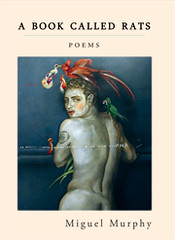
My work has been awarded the Katherine C. Turner Prize from the Academy of American Poets, a Swarthout Award, and has twice been nominated and shortlisted for the Pushcart Prize. My first book, A Book Called Rats, was selected for the Blue Lynx Prize for Poetry (Eastern Washington University Press 2007). I'm curating editor for the online journal of poetry: PISTOLA and my poems and reviews most recently appear in Massachusetts Review, Beloit, Ploughshares and RAIN TAXI. I currently teach writing and literature at Santa Monica College in southern California.
bookcalledrats